Friday, April 4, 2014

My first lesson in Marshallese cooking - Bwiro (fermented breadfruit)!

This past week I experienced a special treat and had my first lesson in making one of the dishes unique to the Marshall Islands - Bwiro. Breadfruit is prepared in various different ways depending on your  location or country.  Bwiro is a lightly sweet dish made from fermented breadfruit and coconut milk.  The Sister missionaries (Sister Butler and Sister Tafili) and I were taught how to prepare it by two wonderful Marshallese sisters that live here on Ebeye, Rosa Loeak and Atrina Katol.  Our little friend, Neitab Nebo also tagged along for the day (she's the sister's little shadow/helper and my dear little friend).   The sister missionaries had some free time on their P-Day (preparation day), so it was a great treat to learn a little bit about the culture of the Marshallese people and learn how to make one of the dishes that is served on special occasions.  I had previously eaten Bwiro, at Viliame's Kemmem (birthday party), and a couple of Iakwe's (going away parties), but I had no idea what I was eating. (Pretty brave of me, huh!?!)  All I knew was that it was made from breadfruit, very dense, and had a slight coconut flavor (that's enough to get me to taste anything), but other than that it was a big mystery.  To tell you the truth, I didn't even know what breadfruit was.  :)  So here goes, here is my little tutorial on Bwiro.
First, what is breadfruit?
Breadfruit (Artocarpus altilis) is a species of flowering tree in the mulberry family, growing throughout Southeast Asia and most of the Pacific Ocean islands. Its name is derived from the texture of the cooked fruit, which has a potato-like flavor, similar to freshly baked bread.
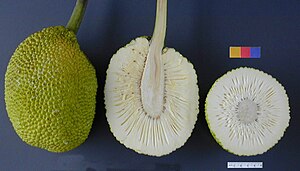
Breadfruit, and cross-section
The Marshallese word for breadfruit = Mā. 
Breadfruit can be baked, boiled, steamed, fried, put in soup and prepared in many different ways.  Some of these ways utilize the breadfruit when it is fresh, but for Bwiro the fruit is fermented.  The fruit is peeled and cored and cut up into pieces.  These pieces are then put into a porous cloth bag.  The bag is then buried underground in a manner that will allow the liquid to drain out of the bag.  These bags can also be stored in coolers, as long as they can have proper drainage.  The bags can be stored for as short a time as three days before using, but generally breadfruit preserved in this manner can be stored for 12 or more months before being eaten. Thus it has long served as an important emergency food in times when food is scarce (for example, following disastrous storms or other natural calamities).  The breadfruit we used had been stored for three years!  Yup, you heard me right, three years!
Here's our little cooking group: Rosa Loeak, Atrina Katol, young boy - sorry, I don't know his name!, Sister Butler, Sister Becker, and Sister Tafili
Sister Loeak and Sister Katol gathered and packed up all our supplies, including the bag of breadfruit, a propane stove, cooking supplies, board, water cooler (for drinking), and water jug to name a few things. Basically everything we would need to make and cook our Bwiro down by the beach.

From their homes we walked down to Beach Park which is located at the southern tip of Ebeye.  I could smell the fermented fruit as we walked down the street with all our supplies. The odor was quite pungent and had a very distinct and unique smell.  You could definitely smell the fermentation.  Curiosity was rising as I was wondering just what we were in for!  We hauled all our supplies right down to the ocean.  The beach is at the southern tip of the land where the water flows through Kwajalein Atoll from the ocean into the lagoon.  Big Bustard Island is just south of us and at a very low tide you can actually walk to Big Bustard Island.
Sister Tafili and Atrina Loeak on the beach.  Big Bustard Island is in the background. On the left side of the water, if you look closely, you can see the ocean waves breaking on the coral reef.  On the right side is the lagoon.  This is where the ocean meets the lagoon!
Now the work starts!  The cloth bag with the breadfruit is then immersed in the fast moving salt water to clean out the fruit.  The bag is put into the water and they work the salty water through the fruit.  Breaking up the pulp and rinsing out the fruit with their hands, they worked and worked and worked the water through the bag and it's contents. 

working the fruit with her hands


working it; breaking down the pulp

working the breadfruit up to their elbows.  You can see the cloudy pulp coming through the bag into the ocean water.
After a thorough washing with the salt water, the bag is taken over to a big piece of concrete and the water is squeezed out of the bag.  The bag is worked over and over until the water is worked out of the bag.  There are several broken pillars of concrete here on the beach from structures that have broken down over the years, but they come in real handy for this purpose. Who would've known!
taking the bag out of the water

Rosa squeezing the water out of the bag while Sister Tafili watches

Atrina's turn at squeezing the water out of the bag.  I think this is why they have such strong arms!


Once they are satisfied that most of the water has been removed from the pulp, the bag is returned to the salt water and the process is started all over again.  They work the bag through and through with their hands and arms until the water coming through the bag no longer looks cloudy.  Then they take the bag back to the concrete block and squeeze the water out again.


Atrina taking a break; isn't she beautiful?

Working the fruit in the salty ocean water, Atrina got right down into the water.
Sister Tafili enjoying the beach
At this point, it is now time for a third round, but this time using fresh water.  Fresh water is worked through the bag after which it is then squeezed one more time to get rid of the excess water.  Whew!  I got tired just watching the process!
Working the fresh water through the breadfruit

Squeezing the water out AGAIN. (don't you love the beautiful colors on their dresses?)

Watching them work! :)
Voila!  The pulp is now a good paste and is ready for the final steps.
Now it is time for the next step to work the pasty pulp with our hands.  A small amount of the pulp is put on a board and worked back and forth with the palm of the hand until it is nice and soft.  It took a few trials, but we finally got the technique. Very fun!  If they are preparing Bwiro for a large group they will have all the women in the family working portions of this paste on large boards.

Atrina showed us the technique. Back and forth, back and forth with the palm of the hand.

My turn to work!

Sister Butler's turn

a little hand action!

Sister Butler and Sister Tafili working double time!

The breadfruit is now ready to be cooked. Coconut milk (yum!), sweetened with sugar, is brought to a boil in a pot.  Small pieces are broken off, rolled, and dropped into the boiling milk.  The fruit is then boiled and cooked for a few minutes.  The milk will boil down and get thick and can be poured over the breadfruit after it has been taken out of the pot.  Now all that is left is to eat and enjoy!
Dropping the fruit into the boiling coconut milk

The finished product!  Bwiro with the sweetened coconut milk

Eating up!

Very dense substance

Atrina, Sister Tafili, and Neitab

Cooking away on the propane stove!


While we were working, Rosa also fixed us some lunch to go with our Bwiro!  She cooked up some rice and then made a stew/corned beef hash/corn mixture.  It was quite yummy!

I had a wonderful afternoon with the Sister missionaries and our Marshallese Sisters. 
Kommol tata (Thank you very much), Rosa and Atrina!

Friday, March 28, 2014

Kwajalein Ferry

On a weekly basis we take the Kwajalein -Ebeye Ferry.  We either go to the Kwajalein Army Base for the day, when we have been sponsored by a Kwajalein resident, or we will go over for lunch and eat  in the ferry terminal.  The ferry schedule varies depending on the day of the week, but it basically runs from morning to night.  Since we are in the Eastern Hemisphere our clocks are set a day ahead (18 hours ahead of the Mountain Time Zone).  The work week schedule on the base is Tuesday through Saturday to coincide with the Monday through Friday military work schedule in the USA.  As a result the weekend on Ebeye for most people is Sunday, Monday.  After WWII ended the Marshallese people living on Kwajalein were moved to Ebeye Island.  The people who live on Ebeye and work on Kwajalein are not allowed to spend the night on Kwajalein so they ride the ferry that is provided by the US Army.  There are two to three ferry boats, but during the middle of the day only one is running.  The exception to this is during work days in the early mornings and late afternoons when two boats are running continuously to ferry the workers from Ebeye to Kwajalein.


Waiting for the new missionaries at the dock with Sister Becker, Sister Butler and Sister Tafili.  The missionaries fly into Kwajalein since there is no room for an airport on Ebeye.


Sister Becker enjoying the ferry ride back to Ebeye.  She is standing on the upper deck on the starboard side.  Kwajalein Island is in the foreground and Little Bustard Island is in the background.

The Ebeye Dock before the new roof construction.  Kajur Power is the building in the background.  We buy our power here and then take the twenty digit number and put it into the meter located inside the apartment.  If the meter ever gets to zero the power goes off.

Ebeye dock where passengers are boarding the ferry.

Ferry docked on Ebeye Island.

Sister Becker standing next to the Kwajalein Ebeye Ferry.

Ferry leaving Ebeye and heading to Kwajalein.

Ferry arriving at the Ebeye dock.
View of Ebeye from the top deck of the ferry.

Sister Becker preparing to leave the ferry.


The ferry ride itself takes about 15 to 20 minutes and it is very relaxing and enjoyable.  There is no fee to ride the ferry and no tickets are required. There are two levels on the ferry.  The lower deck which is enclosed has seating for about 125 passengers and the upper deck which is open has room for a bout 25 passengers.  Marshallese workers that carry a C-Badge (work badge) have priority if the boat happens to fill up.  Sister Becker prefers to ride in the lower deck to get out of the sun, inclement weather, or to avoid the spray from the bow of the ship.  As for me, I love riding on the upper deck so that I can look at the islands that are located between Ebeye and Kwajalein.  There are two very small islands located between Ebeye and Kwajalein called Big Bustard and Little Bustard.  There are very few people that live on each of those islands and there is no electricity.  While riding the ferry I look in the water for sea life.  I have seen quite a bit of sea life when looking off the bow of the ship including sharks, stingrays, sea turtles and a large number of fish.  I do take my chances on the upper deck as I have gotten wet on a number of occasions.  In fact a couple of weeks ago the sea was really rough with four to five foot swells and the ocean spray from the bow of the boat had me drenched from head to foot within five minutes.  It was nice and warm and I loved it the entire time, but Sister Becker did not because I then chose to go down below.  I sat next to her and got her wet from the water dripping off of me.  Oops!

Big Bustard Island is the first island one passes when riding the ferry to Kwajalein.  Notice the outhouse on the coral to the left of the island.


Little Bustard Island is the second island one passes when riding the ferry to Kwajalein.

Big Bustard Island (left) and Little Bustard Island (right)   People do live on the two islands.  One can actually walk to these islands from Ebeye at various times during the month when the tide is very low.


Arriving at the Kwajalein dock

The Kwajalein terminal straight ahead

People filing off the ferry at Kwajalein

Elder Becker at the Kwajalein dock


Freighter on Kwajalein that is bringing fresh produce and other supplies.  The same freighter was on Ebeye the previous day delivering much needed supplies.


A shark between the ferry and the dock on Kwajalein.  Do not fall in the water when getting off the ferry!


The Kwajalein Terminal has a very nice enclosed seating area with a fast-food restaurant called the American Eatery.  They serve a variety of food including burgers, fries, sandwiches, deep fried chicken, and a few other items.  We will quite often order the chicken and bring most of it home to have for another meal later.

The Kwajalein Branch children singing songs to us when we were stuck in the terminal.  We were supposed to get on the island to watch their program for Sacrament meeting that day, but for some reason security didn't allow us on base, so they came and sang to us.  Sweet angels from Heaven!

Elder Becker standing in front of the ferry terminal on Kwajalein Army Base.  This picture is taken on the base itself after one has gone through security.

Leaving Kwaj under a beautiful sunset. 


The dock on Ebeye, where people wait for the ferry, used to have a roof at one time, but over time it gradually decayed.  Most people find shade or cover from the elements by waiting under the awnings at the Triple J Store or by the Kajur Power Office.  They began work on a new cover for the dock about a month ago and who knows when it will be finished. 


Groundbreaking ceremony for the dock roof construction.

Work in progress at the dock.


Construction sign at the Ebeye dock. :)

Tuesday, March 11, 2014

1st Birthday Party/Kemmem for Viliame


THE big celebration and major milestone in a child's life in the islands is when they reach their first birthday.  When a child is born here, and in most of the Pacific Islands, there is very little fanfare.  They are born and then they are blessed.  But once they live through that first year of life, then that is the time of real celebration! Big time!  I have to think this celebration was created generations ago stemming from the low mortality birth rate, especially in the islands.  Years ago the odds of a baby surviving were not very good, so once they made it through their first twelve months, then life was a little more certain on this earth and it was now time to celebrate.  The proud parents, William and Mela Ninjine , good friends of ours (and the cutest couple ever), invited us to their son's first Birthday Party, or Kemmem.  And what a celebration it was!  The only thing I can think of equivalent to this celebration in the United States is a wedding reception.  Invitations go out to all family and friends, a room is reserved, food is prepared, cakes baked, musicians lined up, and prizes and decorations purchased for all the party goers. There were also t-shirts, from Hawaii, for the party goers. This party was held in the restaurant attached to the Ebeye Hotel (the only Hotel on the island).  And most importantly a huge poster is created memorializing the birthday boy - Viliame (like William with a V) Anthony Ninjine.
Viliame's poster and decorated cakes

The honored family, Mela, William, and Viliame Ninjine, with our friend Samson Thomas.  The Ninjine family had matching clothing made for this special occasion
Mike with Mela and Viliame
Lisa with Mela and cute little Viliame


Party goers waiting for the party to begin.  Candy and prizes decorate each table and helium balloons float all about the restaurant.

President Thomas at the mic and getting ready for the music.

Room filled mostly with women and children at the tables and on the floor

And more people.....

Our sweet sister missionaries, Sister Butler (left) and Sister Tafili (right), with Sister Thomas (center) enjoying the meal served to all.  Dinner consisted mainly of rice, noodles, steak, chicken, potato salad, rolls, bread fruit, soda and bottled water.

We were in the small back room (that was air conditioned!) with a few of our dear friends, Pres. Thomas, Branch Pres, Anjain, District Pres. Seremai, and more prizes and candy on the table.

Our beautiful servers, Sister Loeak (left) and another sister.

Mike with the birthday boy

Enjoying a "grandma moment" with Viliame


Mike and Akino Smith (he baked and decorated the cakes where he works on Kwaj army base!)

Mike goofing off with Samson Thomas - comparing their skin tones! Which one is darker??